
Is your epoxy resin still sticky, soft or liquid after it should have cured? Don’t panic! There are several common reasons why resin doesn’t cure properly, and most are related to measuring, mixing, temperature or the products being used.
In this blog, we’ll explain why your resin isn’t curing, how to fix uncured epoxy resin and how to prevent it happening again.
Quick answer: Why is my resin not curing?
The most common reasons epoxy resin doesn’t cure are:
- The resin and hardener were measured incorrectly.
- The resin and hardener weren’t mixed thoroughly enough.
- The temperature is too cold.
- The wrong resin-to-hardener ratio was used.
- Too much pigment, mica or another additive was added.
- The resin and hardener are incompatible.
- The resin has been contaminated with water, oil or another substance.
- The resin is very old or has not been stored correctly.
- The resin has been poured too thinly for the particular product.
- The manufacturer’s curing instructions haven’t been followed.
The first things to check are your mixing ratio, mixing technique and curing temperature. These are among the most common causes of uncured or sticky epoxy resin.
What should properly cured epoxy resin look and feel like?
Once fully cured, most craft epoxy resins should form a hard, durable surface. Depending on the particular resin, the final finish may be glossy, satin or another finish specified by the manufacturer.
If your resin is:
- completely liquid
- runny or gooey
- sticky or tacky
- soft and bendy
- leaving fingerprints
- wet in certain areas
- hard in some places but soft in others
then it may not have cured properly.
However, remember that cure times vary between resin products. Always check the manufacturer’s instructions before deciding that your resin has failed to cure.
Did you know?
Some deep pour resins can take 72+ hours to cure!
10 Reasons Your Resin Isn’t Curing
1. You used the wrong resin-to-hardener ratio
One of the most common causes of uncured epoxy resin is an incorrect mixing ratio.
Epoxy resin normally consists of two components:
- Resin
- Hardener
These need to be combined in the exact ratio specified by the manufacturer.
For example, some products require a 1:1 ratio, while others may require ratios such as 2:1, 3:1 or 5:1.
Never assume that every epoxy resin uses a 1:1 ratio.
Check the instructions on your particular product before measuring.
Adding extra hardener will not make your resin cure faster or harder. An incorrect ratio can actually prevent the resin from curing properly.
Top tip
Keep the manufacturer’s instructions next to you while measuring your resin rather than relying on memory.
2. You didn’t mix the resin and hardener thoroughly enough
Even if you measured the correct amounts, your resin may not cure if the two components haven’t been thoroughly combined.
When mixing epoxy resin, scrape:
- The sides of the cup
- The bottom of the cup
- The corners of the cup
Unmixed resin or hardener can remain around the edges of your mixing container and end up in your project.
This can result in sticky patches or soft spots in an otherwise cured piece. Thorough mixing is essential for the chemical reaction between the resin and hardener to take place properly.
How to mix resin properly
- Measure the resin and hardener according to the manufacturer’s instructions.
- Pour them into a clean, dry mixing cup.
- Stir slowly and thoroughly.
- Scrape the sides and bottom of the cup regularly.
- Continue mixing for the time recommended by the manufacturer.
- Transfer to a clean cup if the manufacturer’s instructions recommend a double-cup mixing method.
- Add pigments only after the resin and hardener have been properly combined, if the manufacturer’s instructions permit this.
3. Your workspace is too cold
Temperature can have a significant effect on epoxy resin curing.
Cold temperatures slow the chemical reaction between resin and hardener, which means your resin can take considerably longer to cure.
If you’re working in a cold room, your resin may remain soft or sticky even though you have measured and mixed it correctly.
Manufacturers provide specific temperature ranges for their products, so always check the instructions for the resin you’re using.
How to help resin cure in cold weather
Try to:
- Work in a room within the manufacturer’s recommended temperature range. We use this space saving low cost heater from Amazon.
- Allow your resin and hardener to reach the recommended working temperature before mixing.
- Give the project additional curing time.
- Avoid placing resin on a cold windowsill, garage floor or other particularly cold surface.
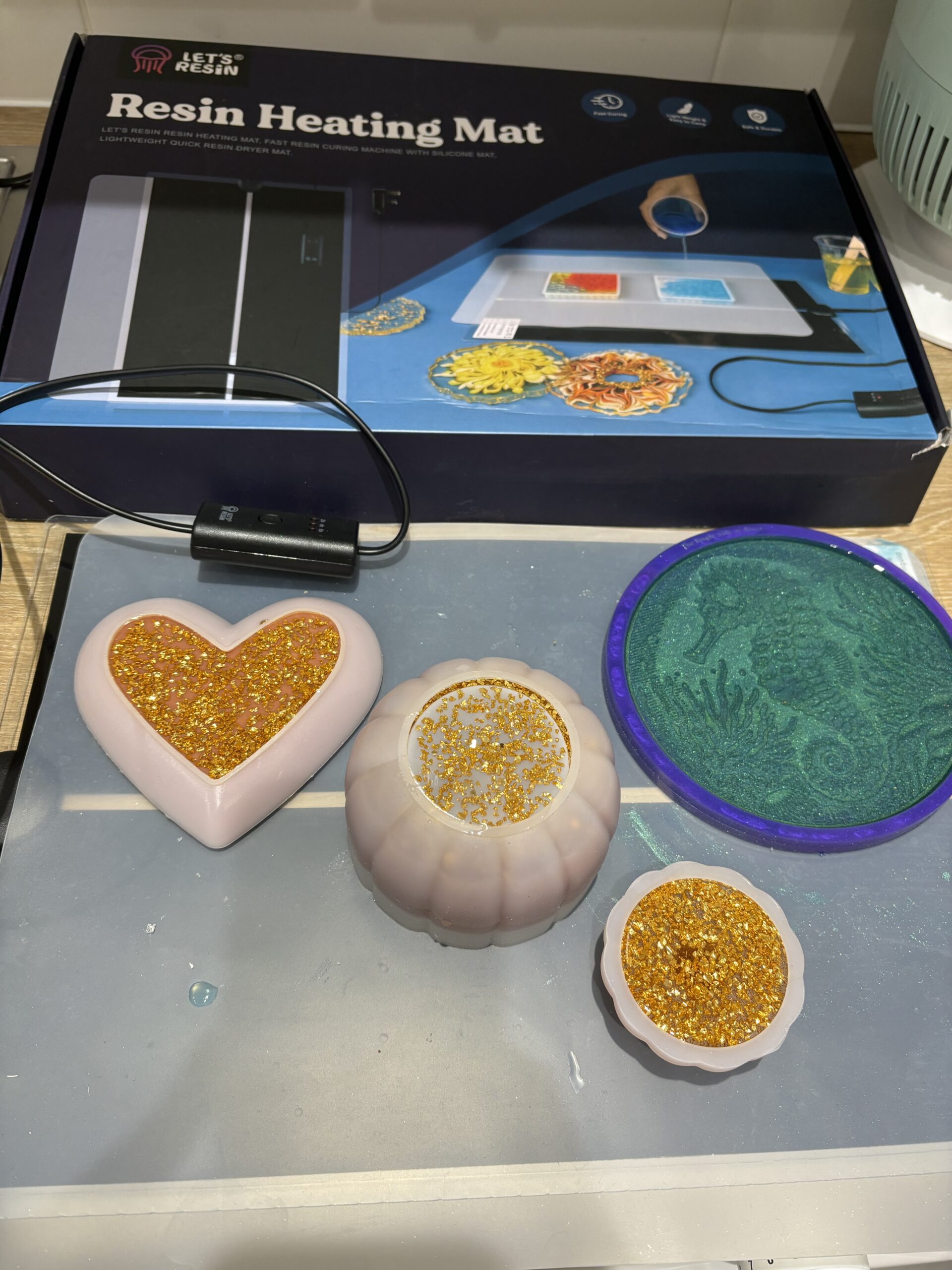
- Use a resin heater like the Resiners CurePro – you can get 15% off with code CULLERCOATS
4. You added too much pigment or another additive
Pigments, mica powders, alcohol inks, glitter and other additives can affect how resin cures if too much is added.
Some resin manufacturers specify maximum amounts of colourant or additives that can be safely used.
For example, ArtResin advises that excessive colourant can contribute to soft or uncured resin.
How much pigment should you add to resin?
There isn’t one universal amount that works for every resin.
Always follow the resin manufacturer’s recommendations for pigments and additives.
If you’re experimenting with a new pigment, test a small amount of resin first rather than risking an entire project.
5. You used the wrong hardener
Not all resin and hardener combinations are interchangeable.
Even if two products look similar, they may have been formulated to work together as a specific system.
Using the wrong hardener, mixing products from different systems or substituting another manufacturer’s hardener can result in curing problems.
Important resin rule
Use the resin with the hardener it was designed to be used with unless the manufacturer specifically confirms compatibility.
6. Your resin or equipment was contaminated
Contamination can also cause problems with resin curing.
Potential contaminants include:
- Water
- Moisture
- Oil
- Grease
- Cleaning products
- Dust
- Residue from previous projects
- Uncured resin from previous mixes
Always use clean, dry measuring and mixing equipment.
Water and epoxy resin can be particularly problematic, and manufacturers recommend using clean, dry equipment for mixing.
Beginner tip
Have a dedicated set of:
- Measuring cups
- Mixing cups
- Silicone mixing tools
- Stirring sticks
- Gloves
for your resin projects.
7. Your resin is too old
Resin and hardener don’t necessarily last forever.
Storage conditions can also affect their performance.
If your resin has been sitting in a cupboard for years, check:
- The manufacturer’s recommended shelf life.
- The storage conditions.
- Whether the containers have been tightly sealed.
- Whether the resin has changed significantly in appearance or consistency.
If you’re unsure about an old product, test a small batch before using it on an important project.
8. Your resin was poured too thinly
Some epoxy resins are formulated for particular applications and thicknesses.
A very thin coating can behave differently from a deep-pour epoxy, and some products may require particular conditions to achieve a full cure.
If you’re making a thin coating, casting a deep mould or creating a large resin project, make sure you’re using a resin designed for that application.
Always follow the manufacturer’s maximum and minimum pour-depth recommendations.
9. You didn’t allow enough curing time
One of the easiest mistakes for beginners is assuming that resin should be completely hard after a few hours.
Many epoxy resins go through several stages during curing.
Your resin may be:
Liquid → Gel-like → Soft → Firm → Fully cured
The exact timings depend on the resin, hardener, temperature, pour depth and project.
A resin that feels soft after 12 or 24 hours isn’t necessarily ruined.
Some products simply need more time.
How long does epoxy resin take to cure?
There isn’t one universal curing time for epoxy resin.
Some products can be demoulded relatively quickly, while others require several days to reach their final cure.
Always use the manufacturer’s stated cure time rather than assuming that all epoxy resin cures at the same speed.
10. You didn’t follow the manufacturer’s instructions
This sounds obvious, but it’s one of the most important points.
Different epoxy resins can have completely different:
- Mixing ratios
- Mixing times
- Working temperatures
- Cure times
- Maximum pour depths
- Pigment limits
- Recommended applications
The instructions supplied with your particular resin should always take priority over general resin advice.
Why is my resin still sticky after 24 hours?
If your resin is still sticky after 24 hours, don’t immediately assume that it has failed.
Check the manufacturer’s recommended cure time first.
If it should already be cured, the likely causes include:
- Incorrect resin-to-hardener ratio
- Incomplete mixing
- Low temperature
- Too much pigment or additive
- Contamination
- Incompatible products
ArtResin identifies inaccurate measuring, insufficient mixing and low curing temperatures among the common causes of sticky resin.
If the resin is only slightly tacky and the manufacturer indicates that additional curing time is appropriate, allow it more time in suitable conditions.
If it remains sticky well beyond the expected cure time, you may need to remove the uncured material.
Why is my resin still soft after 48 hours?
Soft resin after 48 hours can be caused by an incorrect mixing ratio, insufficient mixing, low temperature, excess colourant or other product-specific factors.
Before trying to fix it, check:
1. What does the manufacturer say about cure time?
2. Was the correct ratio used?
3. Was the resin mixed thoroughly?
4. Was the room within the recommended temperature range?
5. Did you add pigment or another additive?
If the resin remains soft beyond the manufacturer’s expected cure time, it may not be capable of curing properly without intervention.
Can you fix resin that hasn’t cured?
Sometimes, but it depends on why the resin hasn’t cured and how far the curing process has progressed.
If the problem is simply that the resin needs more time because of low temperature, moving the project into an appropriate environment and allowing additional curing time may help.
However, if the resin was mixed at the wrong ratio or wasn’t mixed properly, simply waiting longer may not solve the problem.
For resin that remains liquid, gooey or persistently sticky, the uncured material may need to be removed and the project repaired with a correctly measured and mixed batch. In some cases you may be able to scrape and clean with alcohol however you must ensure you have fully removed any uncured resin before adding more. Why? It can reduce adhesion between layers and leak out.
How to fix uncured epoxy resin
If your resin has definitely failed to cure, take care when dealing with the uncured material.
Step 1: Check the manufacturer’s advice
Before doing anything, check the technical information for your specific resin.
Step 2: Protect yourself
Wear the appropriate PPE recommended by the manufacturer, including suitable gloves and eye protection.
Work in a well-ventilated area and follow the product’s safety instructions.
Step 3: Remove the uncured resin
If the resin is still liquid or gooey, carefully remove as much uncured material as possible using silicone tools, baby wipes and alcohol spray – we use this one from Amazon.
Step 4: Clean the surface
Follow the manufacturer’s instructions for cleaning the project and preparing the surface.
Step 5: Allow the surface to dry
Don’t pour fresh resin over a surface containing moisture, residue or uncured material.
Step 6: Prepare a fresh batch
Measure the correct amounts of resin and hardener carefully.
Step 7: Mix thoroughly
Scrape the sides and bottom of your mixing cup while mixing.
Step 8: Apply the fresh resin
Follow the manufacturer’s instructions for application and curing.
Don’t simply add extra hardener to an incorrectly mixed batch in an attempt to make it cure. Changing the ratio can make the problem worse.
Can you pour new resin over sticky resin?
Not always.
If the existing resin hasn’t cured properly, pouring another layer over it may trap uncured material underneath.
The safer approach is to determine why the original resin failed to cure and follow the manufacturer’s repair instructions.
For completely uncured resin, manufacturers may recommend removing it before applying new material.
If the underlying resin has fully cured but the surface has another issue, such as amine blush, the appropriate preparation may be different.
How to prevent resin from not curing
Before you start:
☐ Check the resin and hardener are compatible.
☐ Check the manufacturer’s mixing ratio.
☐ Check whether the ratio is measured by weight or volume.
☐ Check the recommended working temperature.
☐ Make sure your workspace is clean and dry.
☐ Check the resin hasn’t passed its recommended shelf life.
During mixing:
☐ Measure accurately.
☐ Don’t add extra hardener.
☐ Mix thoroughly.
☐ Scrape the sides and bottom of the cup.
☐ Follow the manufacturer’s recommended mixing time.
☐ Add pigments only within the manufacturer’s recommended limits.
After pouring:
☐ Keep the project within the recommended curing temperature.
☐ Protect it from dust.
☐ Don’t move it unnecessarily.
☐ Allow the full recommended cure time.
☐ Don’t demould or sand it too early.
Why does resin cure in some places but not others?
If your project has hard areas and soft or sticky areas, the problem is often related to incomplete mixing or resin/hardener that wasn’t distributed evenly.
This can happen when material stuck to the sides or bottom of the mixing cup gets incorporated into the project.
Thoroughly mixing while scraping the sides and bottom of your container can help prevent this problem.
Why is my resin bendy after curing?
Bendy resin doesn’t necessarily mean that the resin has failed.
Some projects can remain slightly flexible depending on:
- The type of resin
- The thickness of the piece
- The shape of the mould
- The curing time
- The manufacturer’s formulation
If your resin is much softer or more flexible than the manufacturer says it should be, check the mixing ratio, temperature and curing time.
ArtResin notes that soft or bendy resin can be associated with under-mixing, inaccurate measuring, excessive colourant or a thin pour.
What NOT to do if your resin isn’t curing
There are several common “fixes” you might see online that can make the situation worse.
❌ Don’t add extra hardener
More hardener doesn’t automatically mean a harder or faster cure.
❌ Don’t guess the mixing ratio
Always check the manufacturer’s instructions.
❌ Don’t mix random resin brands together
Use compatible resin and hardener systems.
❌ Don’t pour fresh resin over liquid uncured resin
Remove the uncured material and follow the manufacturer’s repair instructions.
❌ Don’t assume every resin cures in 24 hours
Cure times vary considerably between products.
❌ Don’t ignore temperature
Cold conditions can significantly slow curing.
❌ Don’t add lots of pigment
Excessive colourant can interfere with curing in some resin systems.
Frequently Asked Questions
Why is my epoxy resin not curing?
The most common reasons are an incorrect resin-to-hardener ratio, insufficient mixing or curing at too low a temperature. Other possibilities include excessive pigment, contamination, incompatible products or insufficient curing time.
Why is my resin still sticky after 24 hours?
Your resin may need more time, particularly if it has been curing in cool conditions. If it remains sticky beyond the manufacturer’s recommended cure time, check the mixing ratio, mixing technique and amount of pigment or additives used.
Will sticky resin eventually harden?
Sometimes additional curing time can help if the resin is simply curing slowly because of temperature or product-specific cure characteristics. However, resin that has been incorrectly measured or mixed may remain sticky and require removal and repair.
Can I add more hardener to make resin cure?
No. Do not add extra hardener to an incorrectly mixed batch unless the manufacturer specifically instructs you to do so. Epoxy systems are formulated to cure at a specific ratio, and changing that ratio can prevent proper curing.
Does cold weather stop epoxy resin curing?
Cold temperatures can significantly slow epoxy curing and may prevent some products from curing properly within their expected timeframe. Always check the minimum curing temperature for your particular resin.
Can too much mica powder stop resin curing?
It can. Excessive pigment or other additives can interfere with curing in some epoxy systems. Follow the manufacturer’s recommended limits for colourants and additives.
Why is my resin hard in some places but sticky in others?
This is often caused by incomplete mixing or resin and hardener that haven’t been distributed evenly. Scraping the sides and bottom of the mixing cup while stirring helps ensure the two components are thoroughly combined.
Can I fix resin that is still liquid?
If resin remains liquid or gooey after the manufacturer’s expected cure time, it may need to be removed. Whether the project can be salvaged depends on the resin, the project and the reason it failed to cure.
How long does epoxy resin take to cure?
There is no single cure time for every epoxy resin. Cure times vary according to the resin system, hardener, temperature, thickness and application. Always follow the manufacturer’s instructions.
Can you sand resin that hasn’t cured?
No. Resin should be sufficiently cured before sanding. Sanding partially cured resin can create a messy surface and may expose you to uncured material.
Why did my resin cure too quickly?
Epoxy curing produces heat, and larger or thicker quantities can generate more heat and accelerate the reaction. Working temperature and the particular hardener also affect cure speed.