
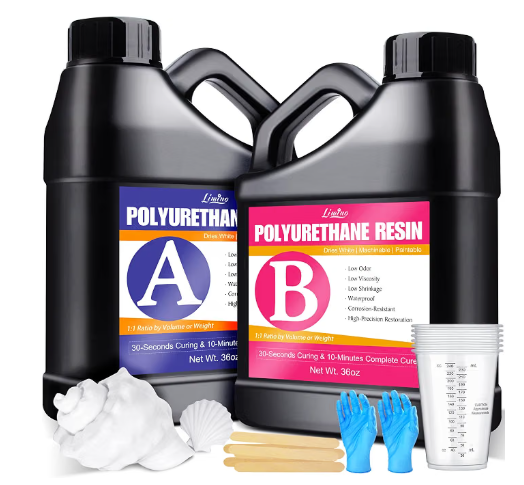
Polyurethane resin is a versatile casting material used to make everything from jewellery and ornaments to models, prototypes, moulds and decorative pieces. It is popular with crafters because it can cure relatively quickly and produces strong, detailed casts.
But what exactly is polyurethane resin, how does it differ from epoxy resin, and is it suitable for beginners?
In this guide, we’ll explain what polyurethane resin is, how it works, what it is used for, its advantages and disadvantages, and how it compares with epoxy resin.
What is polyurethane resin?
Polyurethane resin is a two-part synthetic resin that cures when two components are mixed together. These are generally referred to as Part A and Part B (much like epoxy resin).
When the two parts are combined in the correct ratio, a chemical reaction takes place. The liquid resin gradually hardens to create a solid polyurethane plastic.
Polyurethane resins are available in different formulations, ranging from flexible materials to very hard, rigid plastics. This makes polyurethane resin useful for a wide variety of creative, industrial and manufacturing applications.
For resin crafters, polyurethane casting resin is particularly useful when you want to create fast-curing, detailed molded pieces.
Buy Polyurethane Resin on Amazon.
How does polyurethane resin work?
Polyurethane resin normally consists of two separate components that must be mixed before use.
1. Measure the resin
The two components need to be measured according to the manufacturer’s specified mixing ratio.
Always check the instructions for your particular resin because mixing ratios vary between products.
2. Mix Parts A and B
Once measured, the two components are combined and thoroughly mixed. You’ll need to do this right away as you don’t have long and the resin will start to cure as soon as the liquids mix.
Mix carefully but thoroughly, scraping the sides and bottom of your mixing cup to ensure the components are properly incorporated. Usually only for 5 seconds.
3. Pour into your mould
After mixing, the polyurethane resin can be poured into a suitable mould.
Because many polyurethane casting resins have a relatively short working time (some can only give you 30 seconds), it’s important to have your mold, colours and other materials ready before you start mixing.
4. Allow it to cure
The chemical reaction causes the liquid resin to harden.
Depending on the product, temperature, humidity, thickness of the casting and formulation, polyurethane resin can cure considerably faster than many epoxy resins. Some in only 10 minutes.
Always follow the manufacturer’s recommended curing time.
What is polyurethane casting resin used for?
Polyurethane resin is particularly popular for casting and moulding.
Some common uses include:
- Jewellery and accessories
- Decorative ornaments
- Figurines
- Miniatures and models
- Prototypes
- Replicas
- Hobby components
- Craft embellishments
- Props and costumes
- Small sculptures
- Industrial components
Because polyurethane can capture fine details, it is often used when a mould contains intricate shapes or textures.
Is polyurethane resin good for beginners?
Polyurethane resin can be suitable for beginners, but it isn’t necessarily the easiest resin to start with.
One of the biggest challenges is its relatively fast working time. Some polyurethane casting resins begin curing quickly after Parts A and B are mixed, meaning you need to work efficiently.
This can make it less forgiving than some epoxy resins.
If you’re completely new to resin crafting, it’s worth starting with a product that gives you enough working time to measure, mix and pour without feeling rushed.
Once you’re comfortable with resin safety and mixing techniques, polyurethane resin can be an interesting material to experiment with.
What are the advantages of polyurethane resin?
Polyurethane resin has several benefits that make it attractive for casting and crafting.
Fast curing
One of the biggest advantages is that many polyurethane casting resins cure relatively quickly.
This can be particularly useful if you’re producing multiple pieces and don’t want to wait a long time between casts.
Excellent detail
Polyurethane resin can reproduce fine details from a mould, making it useful for intricate designs, models and small decorative pieces.
Strong and durable
Once cured, many rigid polyurethane resins produce strong, hard-wearing pieces.
Different formulations have different mechanical properties, so always check the manufacturer’s specifications.
Available in different formulations
Polyurethane isn’t just one type of resin.
You can find polyurethane formulations designed to be:
- Rigid
- Flexible
- Tough
- Impact resistant
- Fast curing
- Slow curing
- Suitable for particular casting applications
This versatility is one reason polyurethane is used across both crafting and industry.
Can be colored
Many polyurethane casting resins can be colored using pigments specifically designed for polyurethane resin.
However, always check that your chosen pigment is compatible with the resin you’re using.
What are the disadvantages of polyurethane resin?
Although polyurethane resin has some excellent properties, there are also disadvantages to consider.
Short working time
Fast curing can be an advantage, but it can also be a disadvantage for beginners.
You will have less time to mix, add colour and pour your resin.
Moisture sensitivity
Some polyurethane resin systems are particularly sensitive to moisture.
Moisture can cause problems such as foaming, bubbles or an imperfect surface.
For this reason, it’s important to follow the manufacturer’s storage and handling instructions carefully.
Requires accurate measuring
As with other two-part resins, incorrect mixing can result in curing problems.
Always measure the components according to the manufacturer’s instructions.
Safety precautions are essential
Polyurethane resin should be handled responsibly.
Depending on the formulation, components can present health hazards before they have cured. Always read the manufacturer’s Safety Data Sheet (SDS) and product instructions before use.
Use appropriate PPE, work in a well-ventilated area and avoid skin contact.
Polyurethane resin vs epoxy resin
One of the most common questions beginners ask is:
“What’s the difference between polyurethane resin and epoxy resin?”
The biggest difference between polyurethane resin and epoxy resin is that polyurethane resin will cure in a bright white color, where as epoxy resin will cure clear (unless pigment has been added).
Both materials can be used for casting, but they have different characteristics.
| Feature | Polyurethane Resin | Epoxy Resin |
|---|---|---|
| Working time | Very short (1-2 minutes) | Often longer (approx. 30 minutes depending on brand) |
| Cure speed | Very fast (10-30 minutes) | Usually slower (24-72 hours depending on brand) |
| Detail reproduction | Excellent | Excellent |
| Flexibility | Depends on formulation | Usually rigid when cured |
| Colouring | Will cure white. Compatible pigments required | Will cure clear. Wide range of compatible pigments |
| Large pours | Product dependent | Product dependent |
| Beginner-friendly | Can be more challenging | Often easier for beginners |
| Typical uses | Fast casting, models, components | Jewellery, art, coating, crafts |
The important thing to remember is that there isn’t one resin that is best for every project.
Your choice should depend on what you’re making, how quickly you need it to cure and the properties you want your finished piece to have.
Can you use mica powder in polyurethane resin?
Some polyurethane resin systems can be coloured with mica powder, but you should always check the manufacturer’s recommendations first.
Not every pigment or colourant is compatible with every resin.
If you’re experimenting with mica powder, start with a small amount. Too much pigment can affect the resin’s properties or curing behavior.
For the best results, use colorants specifically designed or recommended for your particular polyurethane resin.
Can you use silicone molds with polyurethane resin?
Yes, polyurethane casting resins can be used with silicone molds.
Silicone molds are particularly popular for resin casting because cured resin generally releases relatively easily from properly prepared silicone.
However, always check that your particular resin and mold are compatible before starting a project.
For detailed designs, make sure the mould is clean, dry and free from contaminants before pouring.
Does polyurethane resin need a UV light?
No. Polyurethane resin does not normally cure using UV light.
Polyurethane casting resin is generally a two-part resin that cures through a chemical reaction between its components.
This is different from UV resin, which requires exposure to ultraviolet light to cure.
It is also different from epoxy resin, which cures through a chemical reaction between its resin and hardener components.
Is polyurethane resin waterproof?
Once fully cured, some polyurethane materials have good resistance to water and moisture.
However, “water resistant” and “waterproof” don’t necessarily mean the same thing.
The performance of polyurethane resin depends on the specific formulation and how it is used.
If your project needs to withstand prolonged exposure to water, check the manufacturer’s technical specifications rather than assuming that all polyurethane resin is waterproof.
Is polyurethane resin food safe?
You should never assume that polyurethane resin is food safe – it’s usually not.
Food-contact suitability depends on the exact formulation and whether the finished product has been tested and certified for food contact.
If you’re making items that will come into contact with food, only use a product that is specifically stated by the manufacturer to be suitable for your intended food-contact application.
Can polyurethane resin be sanded?
Yes. Once fully cured, many rigid polyurethane resins can be sanded, drilled, cut and shaped.
This makes polyurethane useful for models, prototypes and detailed craft projects where some finishing work is required.
When sanding cured resin, wear suitable respiratory protection and take precautions to avoid inhaling dust.
Wet sanding may also help reduce airborne dust, depending on the material and the manufacturer’s recommendations.
Polyurethane resin safety
Resin safety is extremely important, particularly when working with uncured materials.
Before using polyurethane resin:
- Read the manufacturer’s instructions.
- Read the Safety Data Sheet (SDS).
- Wear appropriate gloves.
- Wear suitable eye protection.
- Work in good ventilation.
- Avoid skin contact.
- Keep resin away from food preparation areas.
- Keep products away from children and pets.
- Store components as instructed by the manufacturer.
- Dispose of waste according to local requirements.
Never assume that because a resin has cured, every safety consideration disappears. Follow the manufacturer’s guidance for handling, sanding and finishing the cured material.
Is polyurethane resin better than epoxy resin?
There isn’t a simple answer to whether polyurethane resin is “better” than epoxy resin.
It depends on the project.
Polyurethane resin may be a better choice if you want:
- Fast curing
- Highly detailed casts
- Rigid or flexible casting options
- Production of multiple moulded pieces
- A material suited to models and prototypes
Epoxy resin may be a better choice if you want:
- More working time
- Resin jewellery
- Decorative artwork
- Coating applications
- Larger creative projects
- A resin that’s often more forgiving for beginners
The best resin is the one whose properties match your particular project.
Frequently Asked Questions About Polyurethane Resin
Polyurethane resin is used for casting and molding products such as models, prototypes, figurines, ornaments, jewelry, components and decorative objects.
No. Polyurethane and epoxy are different types of resin systems with different chemical compositions and characteristics. Both can be used for casting, but they have different curing times, properties and applications.
Yes, many polyurethane resins can be colored, but you should use pigments or colorants that are compatible with the specific resin system.
Many polyurethane casting resins cure relatively quickly, although curing times vary significantly between products.
Yes, many polyurethane casting resins are suitable for use with silicone molds. Always check the manufacturer’s instructions before use.
The resistance to yellowing depends on the particular formulation. Some polyurethane products are more resistant to UV exposure and yellowing than others, so check the manufacturer’s technical information.
Final thoughts: Is polyurethane resin worth trying?
Polyurethane resin is a versatile casting material that can be an excellent option for detailed, fast-curing projects.
It can produce strong and highly detailed casts and is available in a wide variety of formulations.
However, its faster curing time and sensitivity to moisture can make some polyurethane systems less forgiving for beginners.
If you’re new to resin, start by learning the basics of measuring, mixing, mould preparation and resin safety before experimenting with polyurethane casting resin.
And remember: always follow the instructions and safety information supplied with your particular resin.
Whether you’re making jewellery, miniatures, ornaments, models or something completely different, understanding the differences between epoxy resin, polyurethane resin and UV resin will help you choose the right material for your project.
Quick answer: What is polyurethane resin?
Polyurethane resin is a two-part casting material that cures through a chemical reaction between two components to create a solid polyurethane material. It is commonly used for detailed casts, models, prototypes, ornaments and other molded objects.
If you’re a resin beginner, polyurethane resin is definitely worth understanding — but make sure you choose the right formulation for your project and always prioritise resin safety.