
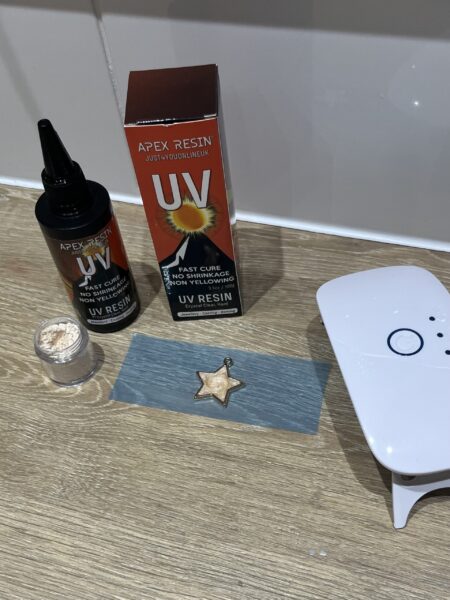
UV resin has become an essential material in resin crafters boxes. But do you know the difference between the viscosities? One of the most important characteristics to consider when selecting a UV resin is its viscosity. The viscosity of a resin directly impacts its flow behavior, application method, curing performance, and final product quality.
In this blog, we’ll look at the differences between high-viscosity and low-viscosity UV resins, their advantages, limitations, and the best applications for each.
What Is Viscosity in UV Resin?
Viscosity refers to a liquid’s resistance to flow. In simple terms, it describes how thick or thin a resin is.
- Low-viscosity UV resins are thinner and flow easily.
- High-viscosity UV resins are thicker and more resistant to movement.
The viscosity level significantly influences how a resin behaves during application and curing.
Low-Viscosity UV Resin
Low-viscosity UV resins typically have a water-like or syrup-like consistency that allows them to spread quickly and penetrate small gaps and intricate structures.
Advantages
Excellent Flow Characteristics
These resins self-level efficiently, creating smooth and uniform surfaces with minimal effort.
Better Penetration
Low-viscosity formulations can easily enter narrow gaps, cracks, and fine details, making them ideal for precision applications.
Reduced Bubble Formation
Because the resin flows freely, trapped air can escape more easily, resulting in clearer and more defect-free finishes.
Faster Processing
The ease of dispensing and spreading can improve production efficiency in high-volume manufacturing environments.
Common Uses
- Fine-detail jewelry casting
- Surface sealing
- Thin-layer coatings
- Anchoring light flowers or inserts
Limitations
- May run or drip on vertical surfaces
- Less suitable for building thick layers
- Can spread beyond intended application areas
High-Viscosity UV Resin
High-viscosity UV resins have a thicker consistency similar to honey, gel, or paste. These formulations are designed to remain in place during application.
Advantages
Superior Gap Filling
High-viscosity resins excel at filling large voids, cracks, and uneven surfaces.
Better Shape Retention
The thicker consistency helps maintain structure before curing, making it suitable for vertical and three-dimensional applications – in particular doming and top coats.
Thicker Coatings
These resins can create substantial coating layers without excessive spreading.
Enhanced Control
Crafters can apply the resin precisely where its needed, reducing waste and improving accuracy.
Common Applications
- Bonding
- Doming
- Thick protective layers
- Bubbles or holel repair work
Limitations
- May trap air bubbles more easily
- Slower self-leveling performance
- Can be more difficult to dispense and process
Comparison: High vs. Low Viscosity UV Resin
| Feature | Low Viscosity UV Resin | High Viscosity UV Resin |
|---|---|---|
| Flowability | Excellent | Moderate to Low |
| Self-Leveling | Excellent | Limited |
| Gap Filling | Limited | Excellent |
| Detail Penetration | Excellent | Moderate |
| Shape Retention | Poor | Excellent |
| Bubble Release | Better | More Challenging |
| Vertical Surface Application | Difficult | Ideal |
| Thick Layer Formation | Limited | Excellent |
How to Choose the Right UV Resin
Selecting the right viscosity depends on your specific resin project requirements. Consider the following factors:
Choose Low-Viscosity UV Resin If:
- You need excellent flow and self-leveling.
- Fine detail reproduction is critical.
- Thin coatings or encapsulation are required.
- Bubble-free clarity is important.
Choose High-Viscosity UV Resin If:
- You need strong gap-filling capabilities.
- The resin must stay in place during application.
- Thick coatings or doming effects are desired.
- Structural bonding strength is a priority.
Final Thoughts
Both high-viscosity and low-viscosity UV resins serve important purposes, and neither is universally better than the other. The best choice depends on the demands of your application, including flow requirements, coating thickness, precision, and curing performance.
By understanding the unique characteristics of each viscosity range, manufacturers and users can optimize production efficiency, improve product quality, and achieve more consistent curing results. Whether you’re working in industrial manufacturing, electronics, coatings, or creative applications, selecting the right UV resin viscosity is a critical step toward success.