
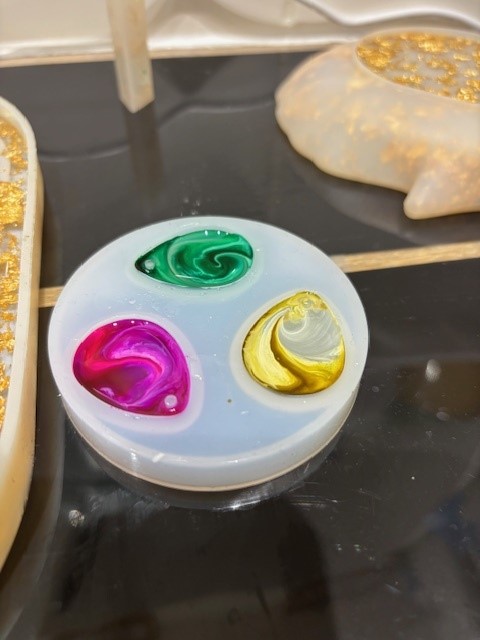
Have you carefully poured your epoxy resin, waited patiently for it to cure, only to discover that your resin is still sticky, tacky or soft?
Don’t panic!
Sticky epoxy resin is one of the most common problems beginners encounter, and in many cases, your project can be saved.
There are several reasons why epoxy resin stays sticky after curing. The most common causes include an incorrect resin-to-hardener ratio, insufficient mixing, low temperatures, using expired resin or attempting to pour the resin too thickly.
In this guide, we’ll explain why your epoxy resin is still sticky, how to fix sticky resin and how to prevent it happening on your next project.
Why is my epoxy resin still sticky?
The most common reasons epoxy resin remains sticky are:
- You used the wrong resin-to-hardener ratio.
- The resin and hardener weren’t mixed thoroughly enough.
- You didn’t scrape the sides and bottom of your mixing cup.
- Your workspace was too cold.
- The resin hasn’t had enough time to cure.
- You poured the resin too thickly.
- The resin or hardener was old or improperly stored.
- You mixed too much colour or another additive into the resin.
- The resin was contaminated.
- The product wasn’t suitable for the project you were making.
Let’s look at each one in more detail.
1. You used the wrong resin-to-hardener ratio
This is one of the most common causes of sticky epoxy resin.
Epoxy resin is made from two components: resin and hardener.
The manufacturer’s instructions will tell you exactly how much of each component you need.
For example, a resin might require a:
1:1 ratio
while another product might require:
2:1
These ratios are not interchangeable.
A common beginner mistake is assuming that every epoxy resin uses a 1:1 ratio. It doesn’t.
Some products are measured by volume, while others are designed to be measured by weight.
How to fix it
Always check the manufacturer’s instructions before mixing.
If the manufacturer specifies a 1:1 ratio by volume, measure equal volumes.
If the instructions specify a ratio by weight, use accurate digital scales.
Don’t guess the ratio.
Adding extra hardener will not necessarily make your resin cure faster. In fact, using the wrong ratio can prevent the chemical reaction from completing properly.
2. You didn’t mix the resin thoroughly enough
Even if you measured the correct amounts, your epoxy resin can remain sticky if the two components weren’t mixed properly.
When resin and hardener are combined, they need to be thoroughly incorporated.
If areas of unmixed resin remain, those areas may stay soft or sticky.
How to mix epoxy resin properly
Pour your measured components into a clean mixing cup and stir slowly and thoroughly.
Scrape:
- The bottom of the cup
- The sides of the cup
- Around the corners
Continue mixing for the amount of time recommended by your resin manufacturer.
Avoid whipping the resin aggressively, as this can introduce unnecessary bubbles.
Slow and thorough is better than fast and aggressive.
3. You didn’t scrape the sides and bottom of the mixing cup
This is an easy mistake to make.
Even when your resin looks completely mixed, some unmixed material can remain around the sides or at the bottom of your mixing cup.
If you scrape that material into your project, you could introduce poorly mixed resin into your mould.
Try the two-cup method
For beginners, one useful technique is the double-cup or two-cup mixing method.
- Measure your resin and hardener.
- Mix them thoroughly in your first cup.
- Scrape the sides and bottom as you mix.
- Transfer the mixture into a clean second cup.
- Mix again carefully.
- Pour into your mould.
This can help reduce the amount of unmixed material making its way into your finished project.
However, always follow the specific instructions supplied with your resin.
4. Your workspace was too cold
Temperature has a significant effect on epoxy resin.
If your workspace is too cold, the chemical reaction between the resin and hardener can slow down considerably.
This can make your resin:
- Take much longer to cure
- Remain soft
- Feel tacky
- Appear cloudy
- Become thicker and more difficult to work with
Many epoxy resins have a recommended working and curing temperature range.
Always check the manufacturer’s instructions for the resin you’re using.
A comfortable, stable room temperature is generally preferable to a cold garage, shed or workshop.
5. Your resin hasn’t finished curing yet
Before deciding that your resin has failed, check how long it has actually been curing.
Epoxy resin doesn’t necessarily become fully hard overnight.
Depending on the product, temperature, thickness and other conditions, curing can take considerably longer.
Your resin may feel:
- Soft
- Slightly tacky
- Flexible
- Less hard than expected
during the early stages of curing.
Check the manufacturer’s cure time
Don’t assume that because the resin is advertised as having a particular cure time, it will always be completely cured within exactly that number of hours.
Temperature and project conditions can affect curing.
If your resin is only slightly tacky and is still within the manufacturer’s stated curing window, give it more time before attempting to fix it.
6. Your resin was poured too thickly
Different epoxy resins are designed for different maximum pour depths.
A coating or art resin isn’t necessarily suitable for a deep mould.
If you pour resin deeper than the manufacturer recommends, several problems can occur.
The resin may:
- Overheat
- Cure unevenly
- Develop cracks
- Remain soft in some areas
- Cure incorrectly
- Produce excessive bubbles
If you’re making a deep project, choose a resin specifically designed for deeper pours.
Never assume that all epoxy resin can be poured to the same depth.
7. Your resin or hardener is old
Epoxy resin has a shelf life.
If you’ve had the same bottles sitting in your craft room for years, the product may no longer perform as expected.
Improper storage can also affect resin.
Exposure to:
- Heat
- Cold
- Moisture
- Direct sunlight
can potentially affect the material.
Before using older resin
Check:
- The manufacturer’s recommended shelf life
- The date of manufacture or expiry, if provided
- How the resin has been stored
- Whether the resin looks or smells different from normal
If you’re unsure, test a small amount before committing it to an important project.
8. You added too much pigment or another additive
Adding colour is one of the most enjoyable parts of resin crafting, but more isn’t always better.
Adding excessive amounts of:
- Mica powder
- Liquid pigment
- Alcohol ink
- Glitter
- Paint
- Other additives
can affect how your resin cures.
The exact limits depend on the resin and the additive you’re using.
How to avoid this
Use colourants specifically designed for resin wherever possible and follow the pigment manufacturer’s recommendations.
If you’re experimenting with a new colourant, make a small test batch first.
This is particularly important when using products that weren’t specifically designed to be mixed with epoxy resin.
9. Your resin was contaminated
Contamination is another possible reason for curing problems.
Your mixing equipment should be:
- Clean
- Dry
- Free from oils
- Free from water
- Free from leftover resin
Even small amounts of contamination can potentially affect your project.
Make sure your moulds are clean and completely dry before pouring resin.
Also avoid introducing water-based products into your epoxy unless the manufacturer specifically states that they are suitable.
10. The resin isn’t suitable for your project
Not all epoxy resin is designed for the same purpose.
You might have:
- Coating resin
- Casting resin
- Deep-pour resin
- Tabletop epoxy
- Jewellery resin
- Art resin
These products can have very different characteristics.
If you use a resin outside its intended application, you may experience curing or performance problems.
Always check the manufacturer’s recommended uses and maximum pour depth.
Can sticky epoxy resin be fixed?
Sometimes, yes.
The best solution depends on why the resin is sticky.
If the resin is only slightly tacky
If you’ve followed the correct mixing ratio and the project is still within its expected curing time, the best solution may simply be:
Wait.
Give it additional time in the recommended temperature conditions.
Don’t immediately sand or recoat it.
What if my epoxy resin is still sticky after several days?
If your resin has been left for several days and is still sticky, soft or wet, something has probably gone wrong.
First, think about the possible causes:
- Was the ratio correct?
- Was it measured accurately?
- Was it mixed thoroughly?
- Was the workspace warm enough?
- Did you add pigment?
- Was the resin within its shelf life?
- Was the pour deeper than recommended?
If you identify the problem, you can decide how best to repair the project.
How to fix sticky epoxy resin
If the resin has cured sufficiently underneath but the surface remains sticky, one possible solution is to remove the uncured material and apply a fresh layer of properly mixed resin.
However, don’t simply pour fresh resin over a surface that is still wet or contaminated.
Step 1: Identify the problem
Work out why the resin failed to cure.
If the underlying resin has been mixed incorrectly, simply adding another layer may not solve the problem.
Step 2: Remove uncured resin
Depending on the condition of your project, you may need to remove the sticky resin.
Use appropriate protective equipment and follow the manufacturer’s guidance for handling uncured resin.
Step 3: Clean the surface
The surface needs to be clean and properly prepared before applying another coat.
Step 4: Allow it to dry
Make sure the project is completely dry before proceeding.
Step 5: Sand if appropriate
If the surface has cured enough to be safely sanded, lightly sanding can help prepare it for a new coat.
Always follow the resin manufacturer’s guidance on surface preparation.
Step 6: Apply a fresh coat
Mix a fresh batch of resin and hardener using the manufacturer’s exact ratio and mixing instructions.
Then apply a new layer according to the product’s instructions.
Can I pour more resin over sticky resin?
Not always.
This is an important distinction.
If the first layer has cured properly but simply needs another coat, adding more resin can be straightforward.
But if the first layer is uncured because the resin and hardener were incorrectly measured or mixed, adding another layer doesn’t fix the underlying problem.
In that situation, you may need to remove the failed resin first.
Can you use a heat gun to cure sticky epoxy resin?
A heat gun can help with bubbles and flow, but it isn’t a magic solution for improperly mixed epoxy.
If the resin hasn’t cured because the ratio was wrong or the components weren’t mixed properly, heating it won’t correct the underlying chemical imbalance.
In fact, excessive heat can create additional problems.
Always use heat cautiously and follow the manufacturer’s instructions.
How to prevent sticky epoxy resin
The easiest way to deal with sticky resin is to prevent it happening in the first place.
Here’s my beginner checklist:
Before mixing
- Check the manufacturer’s instructions.
- Check the resin-to-hardener ratio.
- Check whether the ratio is measured by weight or volume.
- Check the recommended temperature.
- Make sure your resin is within its shelf life.
- Make sure your mould and equipment are clean and dry.
While mixing
- Measure accurately.
- Mix slowly.
- Scrape the sides and bottom of the cup.
- Mix for the manufacturer’s recommended time.
- Don’t add excessive pigment.
- Avoid introducing water or unsuitable additives.
While pouring
- Stay within the recommended pour depth.
- Follow the manufacturer’s working time.
- Remove bubbles carefully.
- Keep your project level.
- Keep the temperature stable.
During curing
- Leave the project undisturbed.
- Keep it in the recommended temperature range.
- Protect it from dust.
- Don’t demould too early.
- Allow the resin to fully cure before using the finished item.
Sticky vs tacky vs soft resin: what’s the difference?
These terms are often used interchangeably, but they can describe slightly different problems.
Sticky resin
The surface feels wet or tacky and may leave residue on your finger.
Tacky resin
The resin may feel slightly sticky but isn’t necessarily wet.
Soft resin
The resin may feel rubbery or flexible rather than hard.
All three can indicate that the resin hasn’t cured correctly — although a resin that is still within its normal curing period may simply need more time.
Frequently Asked Questions
Why is my epoxy resin still sticky after 24 hours?
It may simply need more time to cure, particularly if the temperature is low. Check the manufacturer’s recommended cure time and temperature before attempting to fix it.
Why is my epoxy resin still sticky after 48 hours?
If the resin remains sticky after 48 hours, check the mixing ratio, mixing technique, temperature, pour depth and additives used. Some epoxies require longer to reach full cure.
Why is my resin sticky after a week?
If your resin is still sticky after a week, it’s likely that something has prevented it from curing properly. Incorrect measuring, insufficient mixing and unsuitable curing conditions are common causes.
Will sticky epoxy resin eventually cure?
It depends on the cause. Resin that is simply curing slowly may eventually harden. Resin that has been incorrectly proportioned or contaminated may never fully cure.
Can I sand sticky epoxy resin?
You generally shouldn’t sand resin while it is still soft or sticky. Wait until it has cured sufficiently to be safely sanded and follow the manufacturer’s guidance.
Can I put another layer of resin over sticky resin?
Sometimes, but not if the underlying layer has failed to cure properly. The sticky layer may need to be removed and the surface prepared first.
Does adding more hardener fix sticky resin?
No. Adding extra hardener to already mixed resin isn’t a reliable way to make it cure. Epoxy systems are formulated to react at a specific ratio, so adding extra hardener can create further problems.
Does heat make sticky resin cure?
Warm temperatures can help resin cure within the manufacturer’s recommended temperature range, but heat cannot correct an incorrectly mixed epoxy system. Excessive heat can also cause problems.
Final thoughts
Finding that your epoxy resin is still sticky can be incredibly frustrating, especially when you’ve spent hours creating a project.
But don’t immediately throw it away.
In many cases, the cause can be identified and the project repaired.
The most important things to remember are:
Measure accurately. Mix thoroughly. Work at the recommended temperature. Stay within the recommended pour depth. And give your resin enough time to cure.
Once you understand how epoxy resin behaves, sticky resin becomes much easier to troubleshoot – and you’ll be far less likely to encounter the problem again.
If you’re new to resin crafting, check out our other beginner guides on how to mix epoxy resin, how to stop bubbles in epoxy resin and how to flood coat a resin project.
Happy resin crafting!