
Find out why and how to use a heat gun for resin crafting.
Can You Use a Heat Gun on Epoxy Resin? A Beginner’s Guide
Yes, you can use a heat gun on epoxy resin — and it can be a very useful tool for removing bubbles and creating a smooth finish. However, heat needs to be used carefully. Too much heat, or holding a heat gun too close to your resin, can cause problems such as ripples, scorching, overheating, or even damage to your project.
If you’re new to resin crafting, knowing how to use a heat gun on epoxy resin safely can make a big difference to the finished result.
In this guide, we’ll explain when to use a heat gun, how close to hold it, how long to apply heat, and what mistakes to avoid.
Where to buy heat guns for crafting
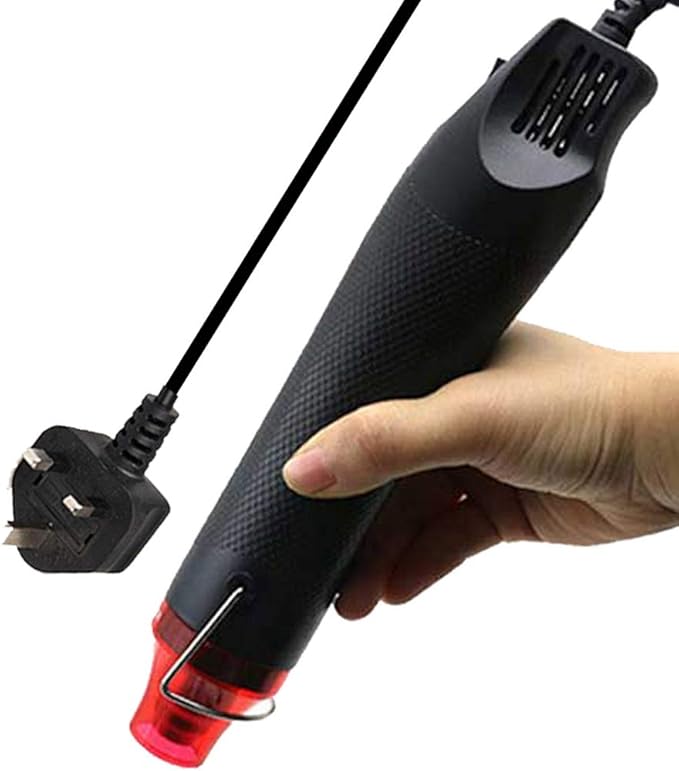
You can get a wide range of craft heat guns on amazon that are under £15 / $20 like this one in the picture which I used a LOT when starting out. It is great but not temperature adjustable and sometimes the nozzle is a bit wide for smaller things like jewellery.
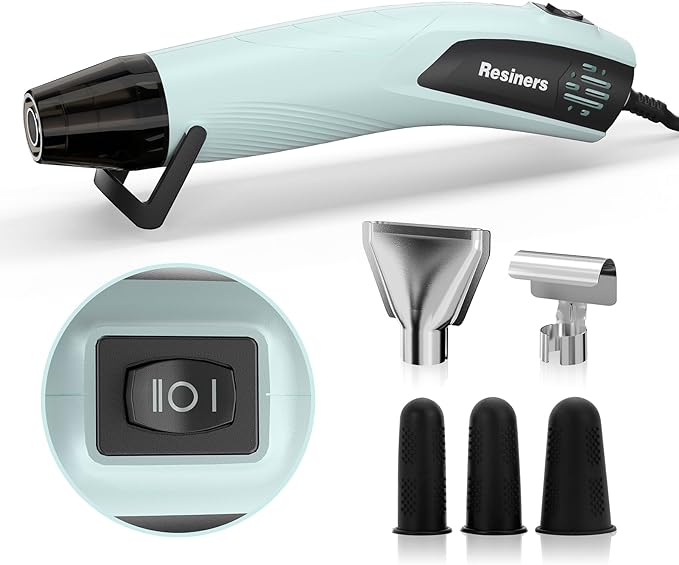
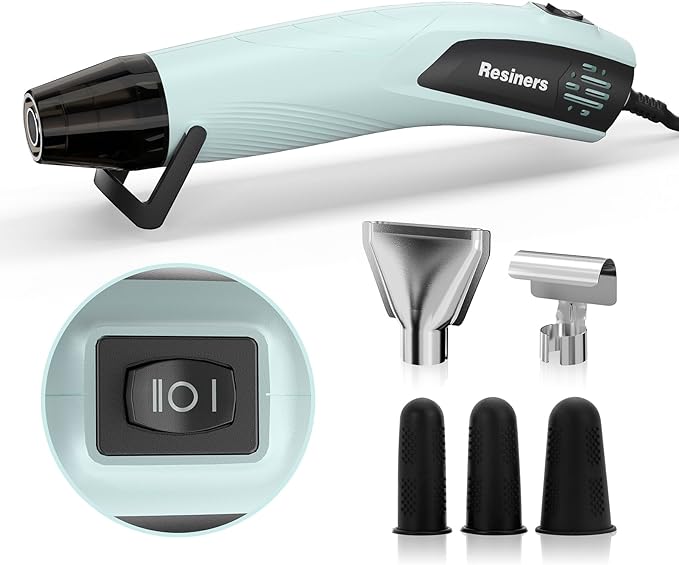
If you’re looking for a heat gun that is temperature adjustable and comes with attachments for smaller pieces and for making ocean scenes / waves with resin, then the Resiners Heat Gun is perfect. When you buy direct from their website (link in the button below) you can choose your plug attachment too to suit your country.
Can You Use a Heat Gun on Epoxy Resin?
Yes. A heat gun can be used on uncured epoxy resin to help remove surface bubbles, improve the appearance of the resin and create certain effects.
When gentle heat is applied to freshly poured epoxy resin, it temporarily reduces the resin’s viscosity. This allows trapped air bubbles to rise to the surface and pop more easily.
A heat gun can therefore be particularly useful when you’re making:
- Resin coasters
- Resin trays
- Resin jewellery
- Resin art
- Resin tables
- Resin mould projects
- Geode resin art
- Ocean resin art
- River tables
- Flood coats
However, a heat gun should always be used with care. Epoxy resin generates heat naturally as it cures, so adding excessive external heat can cause the resin to become too hot.
What Does a Heat Gun Do to Epoxy Resin?
A heat gun essentially warms the surface of the resin, making it temporarily thinner and more fluid.
This can help:
– Remove air bubbles
One of the most common reasons resin crafters use a heat gun is to pop bubbles that have risen to the surface.
Gentle heat causes the bubbles to expand and break, leaving a smoother surface.
– Improve the surface finish
If your freshly poured resin has small surface imperfections, carefully applied heat can help the resin flow and level itself.
– Move resin and create effects
Heat can also be used creatively to move colored resin, particularly when creating ocean, wave and abstract resin art.
However, this requires considerably more control than simply popping bubbles.
Heat Gun vs Hair Dryer for Epoxy Resin
You might be wondering whether you can use a hair dryer instead of a heat gun.
Although both produce warm air, they behave very differently.
A hair dryer generally produces a larger and stronger airflow, which can push your resin around rather than simply warming the surface.
It can also introduce dust, move glitter or pigments, and disturb your carefully poured design.
A heat gun gives you more concentrated heat and, when used correctly, allows you to work on small areas of the resin.
For most resin projects, a low-temperature heat gun designed for crafts is a better choice than a hair dryer.
How to Use a Heat Gun on Epoxy Resin
If you’re using a heat gun to remove bubbles, follow these steps.
1. Pour your resin
Mix your epoxy resin and hardener according to the manufacturer’s instructions.
Pour your resin into your mould, onto your artwork or over your project.
2. Allow the bubbles to rise
Don’t immediately blast the resin with heat.
Give the freshly mixed and poured resin a little time to settle. You’ll often see bubbles gradually rise to the surface.
3. Set your heat gun to a low setting
Start with the lowest temperature and airflow setting that works for your particular heat gun.
You can always increase the heat if necessary, but it’s much easier to accidentally overheat resin than it is to reverse the damage.
4. Keep the heat gun moving
This is one of the most important rules.
SAFETY TIP: Never hold a heat gun in one place for a prolonged period.
Move it continuously over the surface of the resin using short, controlled movements.
Think of it as briefly sweeping heat across the surface rather than trying to “cook” the resin.
Why? It can cause a flash cure if you heat your resin too quickly for too long.
5. Keep the heat gun away from the resin
Avoid placing the nozzle directly against the resin.
The exact distance depends on your particular heat gun, its temperature and airflow, so follow the manufacturer’s instructions and start further away until you understand how your tool behaves.
6. Check the surface
Once the bubbles have disappeared, stop applying heat.
You don’t need to keep heating the resin once the surface is smooth.
How Long Should You Use a Heat Gun on Epoxy Resin?
There isn’t one exact time that works for every project.
The amount of heat required depends on:
- The type of epoxy resin
- The resin’s viscosity
- The temperature of your workspace
- The thickness of the pour
- The size of your project
- The temperature of your heat gun
- How many bubbles are present
For bubble removal, short bursts of heat are usually better than prolonged heating.
Apply heat briefly, check the surface and repeat if necessary.
Remember: the goal is to pop bubbles — not to heat the entire resin project.
Can a Heat Gun Make Epoxy Resin Cure Faster?
Heat can speed up the curing reaction of epoxy resin.
However, deliberately using a heat gun to accelerate curing isn’t generally recommended unless the resin manufacturer specifically says that additional heat is suitable for that product.
Epoxy curing is a chemical reaction that naturally produces heat. Adding too much additional heat can cause the resin to cure too quickly or become excessively hot.
This can potentially lead to:
- Cracking
- Yellowing
- Warping
- Ripples
- Excessive bubbling
- A damaged mould
- An uneven surface
For beginners, it’s much safer to control the environment around your resin rather than trying to force the resin to cure with a heat gun.
Can You Use a Heat Gun to Remove Bubbles From Resin?
Yes. Removing bubbles is one of the best uses for a heat gun when working with epoxy resin.
After pouring your resin, inspect the surface for small bubbles.
Move the heat gun gently over the surface. As the resin warms, its viscosity decreases and surface bubbles can pop.
You may need to repeat the process several times during the early stages of your project.
Don’t forget that bubbles can continue rising from deeper within the resin, particularly with thicker pours.
Can You Use a Heat Gun on Resin Molds?
Yes, but be particularly careful.
Many resin molds are made from silicone, which can tolerate some heat, but that doesn’t mean you should expose the mold to high temperatures for prolonged periods.
Excessive heat can potentially:
- Damage or distort the silicone mould
- Overheat the resin
- Affect your project
- Increase the risk of an uncontrolled curing reaction
Always check the manufacturer’s instructions for your mold and resin.
Can You Use a Heat Gun on Cured Epoxy Resin?
A heat gun can be used on cured epoxy resin in some circumstances, but this is very different from using heat to remove bubbles from freshly poured resin.
Applying significant heat to cured epoxy can soften or alter the resin, depending on the product and temperature.
If you’re trying to repair, reshape or remove cured epoxy resin, don’t assume that a heat gun is the best solution.
Always check the manufacturer’s technical information before applying significant heat to cured resin.
What Happens If You Overheat Epoxy Resin?
Overheating resin can cause a number of problems.
1. Your resin can become too fluid
Excessive heat can make the resin extremely runny, causing it to move away from where you poured it.
2. Your resin can develop ripples
If you’re working on a flood coat or flat surface, excessive heat can disturb the surface and leave unwanted waves or ripples.
3. You can create more bubbles
Although gentle heat can remove bubbles, excessive heat can cause trapped air or moisture to behave unpredictably and may introduce new imperfections.
4. The resin can cure too quickly
Epoxy resin produces heat as it cures. Adding additional heat can accelerate the reaction.
5. Your project can become damaged
Too much heat can contribute to cracking, warping, yellowing or other unwanted changes.
Heat Gun Safety When Working With Epoxy Resin
A heat gun gets extremely hot, so take appropriate precautions. Always:
- Work in a well-ventilated area.
- Wear the appropriate PPE recommended by your resin manufacturer.
- Keep the heat gun away from flammable materials.
- Never leave a switched-on heat gun unattended.
- Allow the heat gun to cool before storing it.
- Keep children and pets away from your workspace.
- Follow the manufacturer’s instructions for both your resin and heat gun.
Always place your heat gun on a heat resistant surface like a heat resistant silicone mat when you are finished with it and remove it from the plug / outlet.
Important: A heat gun is not a substitute for good resin preparation. Correct measuring, thorough mixing, suitable room temperature and following the resin manufacturer’s instructions are all important for successful curing.
Should Beginners Use a Heat Gun on Epoxy Resin?
Yes — a heat gun can be a very useful tool for beginners.
However, the key is using less heat rather than more.
If you’re using a heat gun for the first time, practise on a small project before using it on something important.
Start with:
- A low heat setting
- A greater distance from the resin
- Short bursts
- Constant movement
- Frequent checks of the surface
Once you understand how your particular resin responds to heat, you can adjust your technique.
Frequently Asked Questions
Can I use a heat gun to pop bubbles in epoxy resin?
Yes. A heat gun can be used to gently warm the surface of freshly poured epoxy resin, helping surface bubbles rise and pop.
Is a heat gun better than a lighter for resin bubbles?
A heat gun designed for crafting can give you greater control than an open flame. An open flame can be dangerous around resin and may scorch the surface, so follow your resin manufacturer’s recommendations and use suitable equipment.
Can you use a hairdryer instead of a heat gun for resin?
You can, but it isn’t usually the best option. Hairdryers produce more airflow and can disturb resin, glitter and pigments. A suitable craft heat gun generally provides more controlled heat.
How close should a heat gun be to epoxy resin?
There isn’t one universal distance because heat guns vary considerably. Start further away, use a low setting and follow the instructions supplied with your heat gun. Keep it moving and avoid concentrating heat on one area.
Can you use a heat gun on UV resin?
UV resin is different from epoxy resin, so always check the manufacturer’s instructions. Excessive heat can affect resin projects, and UV resin should be cured according to the product’s recommended curing method.
Can heat make epoxy resin cure faster?
Yes. Increasing the temperature can accelerate epoxy’s curing reaction. However, deliberately applying excessive heat isn’t recommended unless the resin manufacturer specifically recommends it.
Why does my resin bubble when I use a heat gun?
If you’re seeing lots of bubbling after applying heat, you may be applying too much heat or heating the resin for too long. Try reducing the temperature, increasing the distance and using shorter bursts.
Final Thoughts
So, can you use a heat gun on epoxy resin? Absolutely.
A heat gun can be one of the most useful tools in a resin crafter’s kit, particularly for removing surface bubbles and helping create a smooth finish.
The secret is gentle, controlled heat.
Don’t hold the heat gun in one place, don’t get the nozzle too close to the resin and don’t keep heating the project once the bubbles have disappeared.
When you’re working with epoxy resin, remember that more heat doesn’t mean better results. Start gently and gradually learn how your particular resin behaves.
Ready to learn more about resin?
If you’re new to epoxy resin, check out our other beginner-friendly guides covering how to mix epoxy resin, how to prevent bubbles, why resin stays sticky and how to choose the best resin for beginners.
SAFETY ADVICE
Always ensure you are careful using a heat gun. Remember, they get REALLY hot.