
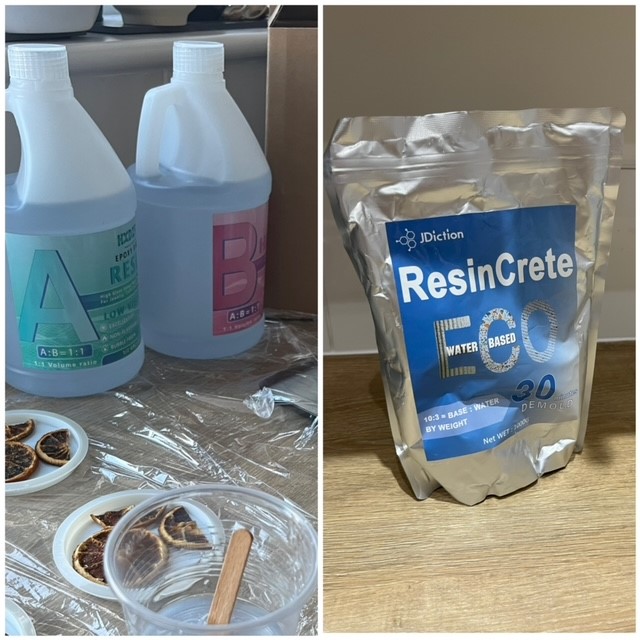
How does Epoxy Resin compare to Eco Resin like Apex Eco Pour H2O, JDiction ResinCrete and Jesmonite? What is the difference and which is better value for money? Not sure which resin to buy? Start with our guide to the best resin for beginners, where we compare the most suitable options for different types of resin projects.
Choosing between epoxy resin and eco resin can be confusing, especially if you are new to resin crafting. Although both materials can be used to create beautiful handmade projects, they have different ingredients, finishes, working times and ideal uses.
The best choice depends on what you want to make. Epoxy resin is often the better option for clear, glossy projects containing flowers, photographs or glitter, while eco resin is popular for creating solid, stone-like home décor such as trays, coasters and candle holders.
In this guide, we’ll explain the difference between epoxy resin and eco resin, compare their advantages and disadvantages, and help you decide which one is right for your project.
What is the difference between epoxy resin and eco resin?
The main difference is that epoxy resin is usually a two-part liquid system, while eco resin is often a powder-based material that is mixed with water or a special liquid, depending on the brand.
Eco resin products vary between brands. Some are mixed with water, while products such as Jesmonite use a powder and liquid system. This means that you should always check the manufacturer’s instructions before mixing or using either type of resin.
Epoxy resin vs eco resin: quick comparison
| Feature | Epoxy resin | Eco resin |
|---|---|---|
| Appearance | Usually clear and glossy | Usually opaque with a stone-like finish |
| Mixing | Resin and hardener | Powder and water or liquid, depending on the brand |
| Best for | Coatings, jewellery, photographs and encapsulation | Coasters, trays, pots and home décor |
| Working time | Often around 30–60 minutes, depending on the product | Often shorter, commonly around 20–30 minutes |
| Finish | Glossy, smooth and often transparent | Usually matt, satin or stone-like |
| Colour | Can be clear, translucent or opaque | Usually naturally white, cream or coloured |
| Curing | Can take several hours or longer | May demould quickly but require additional time before sealing |
| Waterproofing | Depends on the product and application | Usually needs sealing or waxing for improved water resistance |
| Safety | Requires careful handling, ventilation and suitable PPE | Still requires safe handling and attention to manufacturer guidance |
These characteristics vary between brands, so the product instructions should always take priority over general comparisons.
What is epoxy resin?
Epoxy resin is a liquid material that normally comes in two parts: resin and hardener. When the two parts are mixed in the correct ratio, a chemical reaction takes place and the mixture gradually hardens.
Epoxy resin is commonly used for:
- Resin jewellery
- Coasters
- Keyrings
- River tables
- Resin art
- Coating surfaces
- Preserving dried flowers
- Encapsulating photographs and keepsakes
- Adding a glossy finish to craft projects
One of the biggest advantages of epoxy resin is that it can be clear and glossy, making it particularly useful when you want the contents of your project to remain visible.
You can also add materials such as:
- Mica powder
- Pigment paste
- Alcohol ink
- Glitter
- Dried flowers
- Sand and shells
- Small photographs or paper designs
Epoxy resin is available in different formulations, including fast-curing resin, deep-pour resin and coating resin. The correct type will depend on the size and purpose of your project.
What is eco resin?
Eco resin is a broad term used for several different powder-based or environmentally focused resin products. Many craft eco resins are mixed with water or a liquid activator to create a material that sets into a solid, stone-like finish.
Eco resin is often used to make:
- Trinket trays
- Coasters
- Candle holders
- Plant pots
- Soap dishes
- Decorative bowls
- Home décor
- Terrazzo-style projects
- Small sculptures
- Jewellery and accessories
Unlike epoxy resin, eco resin is usually opaque rather than transparent. It often starts as a white or cream-coloured mixture, which can then be coloured using suitable pigments.
Eco resin can be decorated with:
- Eco resin pigment
- Mica powder, where compatible
- Terrazzo chips
- Glitter
- Dried flowers
- Paint
- Gold or metallic detailing
The final appearance depends on the brand, pigment, mould and sealing method used.
Which resin gives the best finish?
The best finish depends on the style of project you want to create.
Epoxy resin finish
Epoxy resin is usually the better choice if you want:
- A clear finish
- A glossy surface
- A glass-like appearance
- Visible inclusions
- Transparent layers
- A smooth coating
It is ideal for projects where you want to see flowers, photographs, glitter or decorative objects suspended inside the resin.
Eco resin finish
Eco resin is usually better if you prefer:
- A solid colour
- A natural stone appearance
- A matt or satin finish
- A modern home décor style
- Terrazzo effects
- Painted or metallic details
Eco resin can create a more substantial, ceramic-like appearance, making it particularly attractive for trays, pots and decorative objects.
Which resin is easier for beginners?
Both materials can be suitable for beginners, but they have different learning curves.
Epoxy resin requires you to:
- Measure the resin and hardener accurately.
- Mix the two parts thoroughly.
- Avoid introducing excessive bubbles.
- Work within the resin’s pot life.
- Allow the project to cure fully.
Eco resin often requires you to:
- Measure the powder and liquid accurately.
- Mix without creating excessive air bubbles.
- Pour into the mould promptly.
- Allow the piece to set before demoulding.
- Sand, paint or seal the finished item if required.
Eco resin may feel simpler because it does not usually involve the same two-part liquid mixing process as epoxy resin. However, it can set quickly, so you still need to prepare your molds, tools and workspace before mixing.
Is eco resin more environmentally friendly than epoxy resin?
The term “eco resin” does not automatically mean that a product is completely sustainable or harmless to the environment. Different products use different ingredients and manufacturing methods.
Some eco resin products are designed to have lower odour, use mineral-based powders or be easier to clean up with water. However, environmental claims should always be checked against the specific product information rather than assumed from the name alone.
Epoxy resin products also vary considerably. Some modern formulations are marketed as low-odour or low-VOC, but this does not mean that every epoxy resin is the same.
Regardless of the resin you choose:
- Follow the manufacturer’s safety instructions.
- Work in a well-ventilated area.
- Wear suitable gloves and eye protection.
- Keep resin materials away from children and pets.
- Avoid washing uncured resin into sinks or drains.
- Dispose of leftover materials responsibly.
Is eco resin cheaper than epoxy resin?
The cost depends on the brand, pack size and type of project.
Epoxy resin is widely available in starter kits and larger bottles, which can make it cost-effective for some projects. Eco resin may appear more expensive per packet, but the amount needed will depend on the size and shape of your mold.
When comparing prices, check:
- The total weight of the product
- The mixing ratio
- How much finished material it produces
- Whether water or a separate liquid is required
- Whether you need to buy a sealer or wax
- Whether the product can be used for your intended project
The cheapest resin is not always the best value if it produces a finish you do not want or requires additional products.
Which resin is best for coasters?
Both epoxy resin and eco resin can be used to make coasters, but they create very different results.
Choose epoxy resin if you want:
- Clear coasters
- Glitter-filled designs
- Floral coasters
- Ocean-style effects
- A glossy finish
- Transparent layers
Choose eco resin if you want:
- Terrazzo coasters
- Marble-effect coasters
- Neutral home décor
- A stone-like finish
- A matt or satin appearance
- A more substantial coaster
Eco resin coasters will usually need to be sealed correctly, particularly if they will come into contact with water, drinks or condensation.
Can you mix epoxy resin and eco resin?
It may be possible to use epoxy resin and eco resin in the same project, but you should not assume that they can be mixed together or layered immediately.
If you are combining them:
- Check that both products are compatible.
- Allow the first material to cure fully where required.
- Follow the manufacturer’s instructions.
- Test the combination on a small project first.
- Avoid relying on one product to seal or protect the other unless compatibility has been confirmed.
For example, you may be able to use epoxy resin as a glossy coating over a fully cured eco resin project, but the surface may need to be dry, clean and properly prepared first.
Epoxy resin or eco resin: which should you choose?
Choose epoxy resin if you want to:
- Preserve photographs or flowers
- Create clear jewellery
- Make glossy resin art
- Encapsulate decorative objects
- Create transparent layers
- Coat a surface
Choose eco resin if you want to:
- Make trays and coasters
- Create stone-like home décor
- Experiment with terrazzo effects
- Make candle holders or plant pots
- Work with solid, opaque colours
- Create a matt or satin finish
Our recommendation
For clear projects containing flowers, photographs, glitter or decorative inclusions, epoxy resin is usually the most suitable option.
For solid home décor projects with a stone, ceramic or terrazzo appearance, eco resin is often the better choice.
There is no single resin that is best for every project. The right material depends on the finish, durability, working time and purpose of the item you want to create.
Frequently asked questions
Is eco resin the same as epoxy resin?
No. Eco resin and epoxy resin are different materials. Epoxy resin is usually a two-part liquid system, while many eco resin products are powder-based and are mixed with water or a special liquid.
Is eco resin waterproof?
Eco resin is not automatically waterproof. Many eco resin projects need to be sealed or waxed to improve their resistance to water. Always check the instructions for your specific product.
Is epoxy resin stronger than eco resin?
The strength of both materials varies between brands and formulations. Epoxy resin is often valued for its durability and chemical resistance, while eco resin can be strong and suitable for decorative objects when mixed, cured and sealed correctly.
Can you use mica powder in eco resin?
Some eco resin products can be coloured with mica powder, but compatibility varies. Use a pigment recommended by the manufacturer and test a small amount before colouring a complete batch.
Which resin is best for beginners?
Both can be suitable for beginners. Epoxy resin is useful for clear, glossy projects, while eco resin can be a good choice for simple solid-colour home décor. Your choice should depend on the project you want to make.
Does eco resin smell less than epoxy resin?
Many eco resin products have a lower odour than traditional epoxy resin, but this varies between brands. You should still follow the product’s safety instructions and work in a well-ventilated space.
Final thoughts
Epoxy resin and eco resin are both useful materials for creative projects, but they are designed to produce different results.
Epoxy resin is best for clear, glossy and encapsulated designs. Eco resin is best for solid, stone-like and home décor projects.
Before buying, consider the finish you want, the size of your mould, the time available for mixing and curing, and whether the finished project will need sealing.
Always read the manufacturer’s instructions, as working times, mixing ratios, curing times and safety requirements can vary significantly between products.
Always make sure you check out the instructions for the type of resin you choose to buy. Instructions and safety advice will vary a lot between brands.